We build models and algorithms to learn about the world.
We are a computational biology research group at
Fred Hutch supported by
HHMI.
We love learning about evolution and immunity, as well as mathematics and algorithms.
We're fluent in modern machine learning, but use methods that respect the problem structure.
Models built on biological mechanism
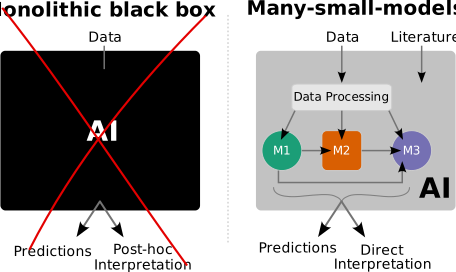
We build open-box models whose parts map onto real biological processes, so their parameters can be interpreted and learned from. For example, our deep selection models separate the natural selection that shapes antibodies from the hypermutation that generates their diversity, outperforming much larger language models. We love simpler models too, for example exploring how mutation rate of SARS-CoV-2 varies across its genome, how deep mutational scans shift mutational constraints, and how clonal interference shapes antibody escape. Taking the biology seriously makes the models better, not worse.
Algorithms that leverage the structure of the data
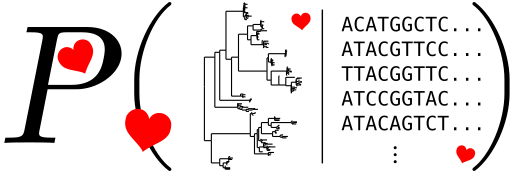
Biological data has structure, and good algorithms use it rather than flattening it away. For example, we think that a sequence alignment is best read through an evolutionary tree. So instead of replacing classical methods with a generic neural network, we teach the network why the classical method works. Sometimes we prove theorems to arrive at just the right object to work with, such as in our recent work developing a bijection between a type of ranked tree shape and a class of matrices, enabling autoregressive generative models (work in progress). Relatedly, we have a longstanding interest in finding the right structure to express collections of phylogenetic trees in a phylogenetic posterior distribution.
We get to work this way because we love the biology, the statistics, and the code.
That combination isn't common, but if it sounds like you, get in touch.

Thank you to taxpayers and private foundations for supporting our work.